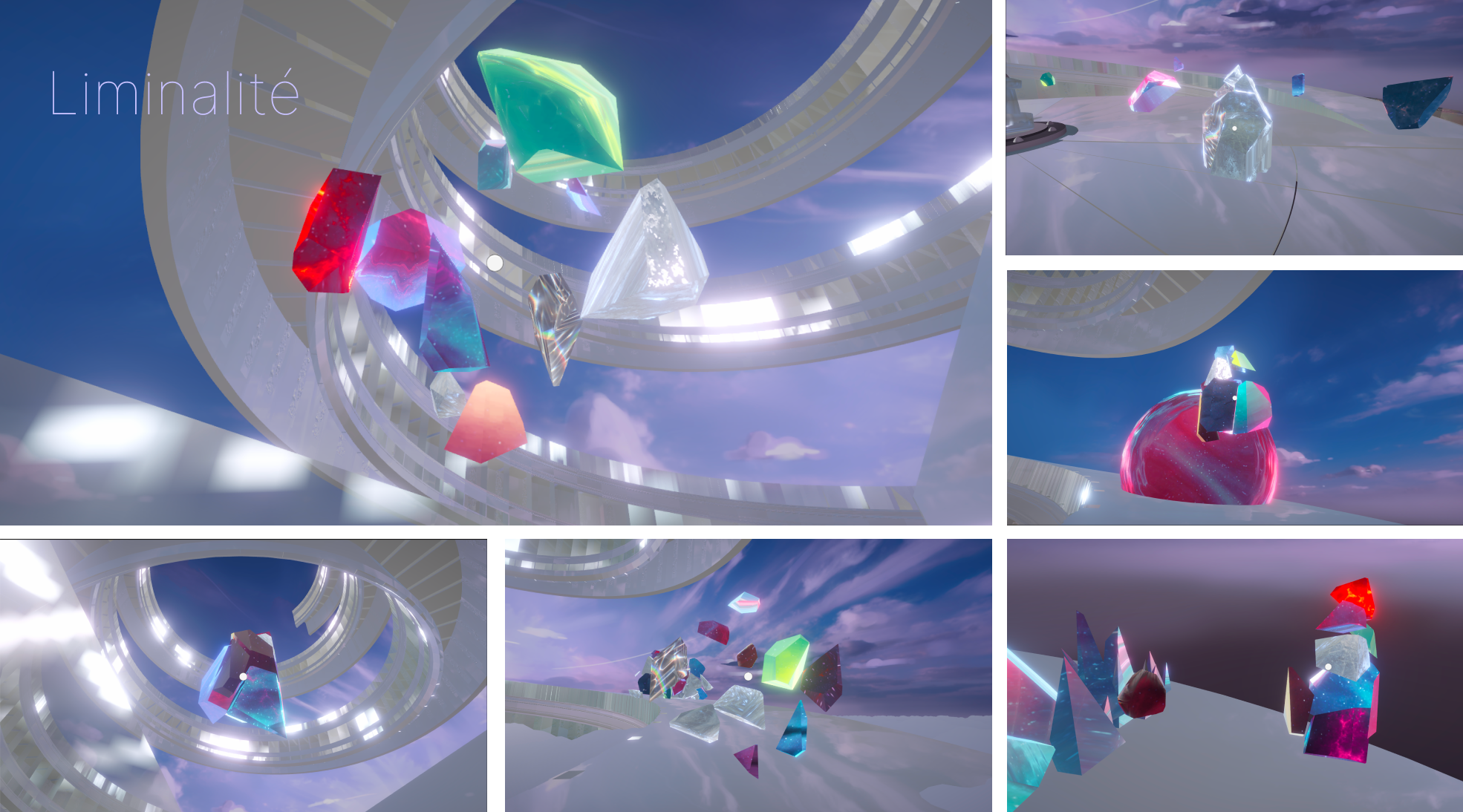
Liminalité
A 3D Game Exploring the Fracture and Reformation of the Self's Architecture. | Date: 2025/12
In an age of accelerating social rhythms and shifting relationship landscapes, we find ourselves constantly reconfigured—entering new teams, leaving old circles, relocating to unfamiliar cities, ending chapters of our lives. Each transition fractures the self into multiple facets, each holding different expectations, different versions of "who I am."
BACKGROUND
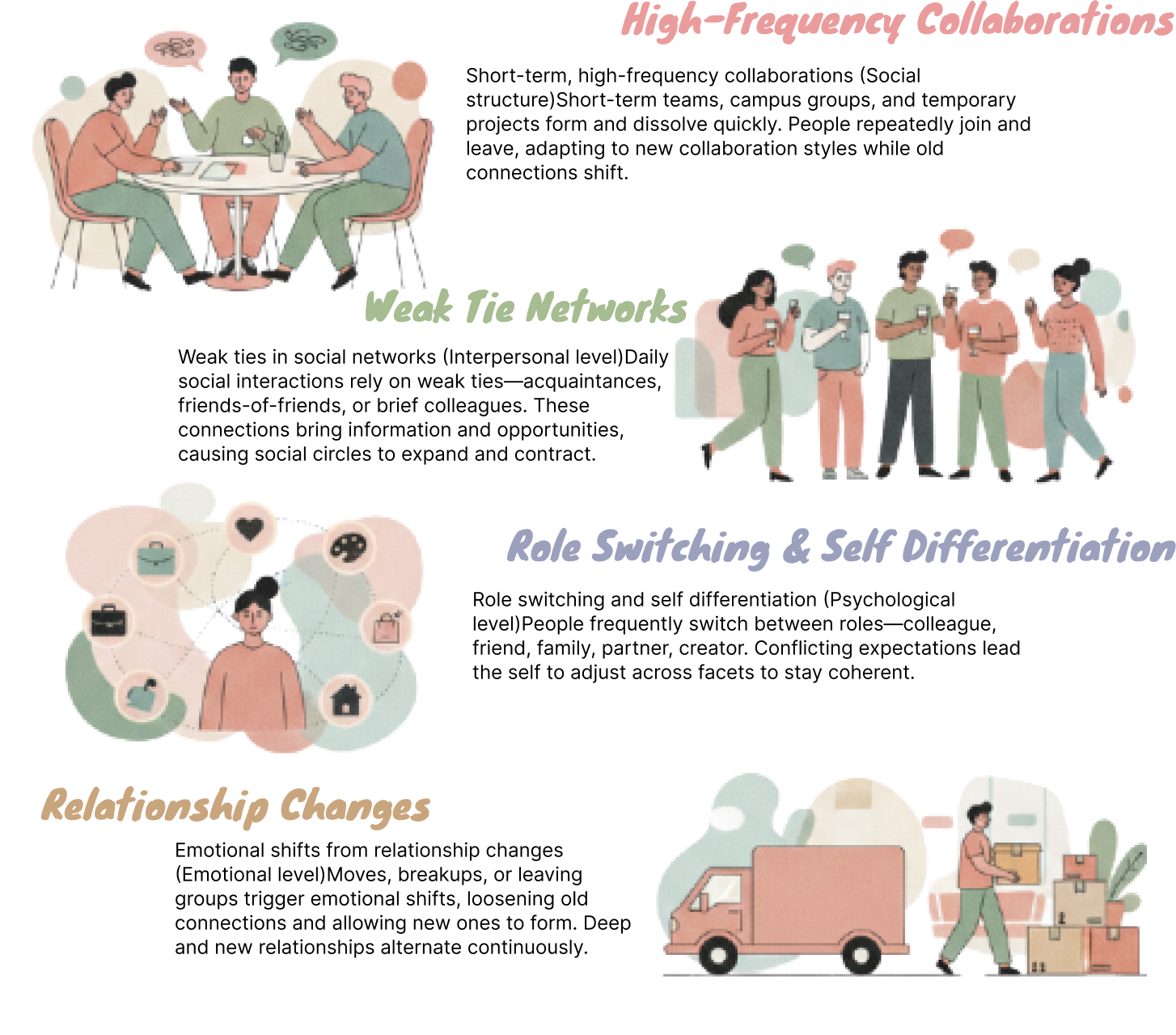
In today’s fast-paced life, people constantly move through changing relationships—joining new teams, leaving old circles, moving cities, or ending connections. Each time, they experience themselves in shifting roles, and changes in one area can ripple through their sense of self.
New environments, people, and opportunities push them to reposition, redraw boundaries, and reconsider who they are. Platforms, networks, and algorithms speed up this flow, making the rhythm of relationships quicker and alternating between holding onto old structures and adapting to new ones. The self is no longer fixed, but an open structure, adjusting across social contexts.
RESEARCH
Self-Construal Theory (Markus & Kitayama, 1991)
Independent self emphasizes stability; interdependent self emphasizes context and relational adjustment. Both coexist and shift with situations.
Strength of Weak Ties (Granovetter, 1973)
Strong ties bring depth; weak ties broaden information and connections. Together, they shape social networks.
Identity Negotiation Theory (Ting-Toomey, 1993)
Individuals adjust their identities across contexts. Digital environments speed up these shifts.
The self today forms through ongoing adjustments. People cycle through “relationship changes—role shifts—new connections”, with depth, breadth, stability, and flexibility playing shifting roles. The self emerges from these dynamics rather than remaining fixed.
PROJECT
design purpose
To show how changing relationships shape the self through a visual game, letting players notice subtle, ongoing shifts in daily life and understand their structural changes amid a fast-paced world.
concept
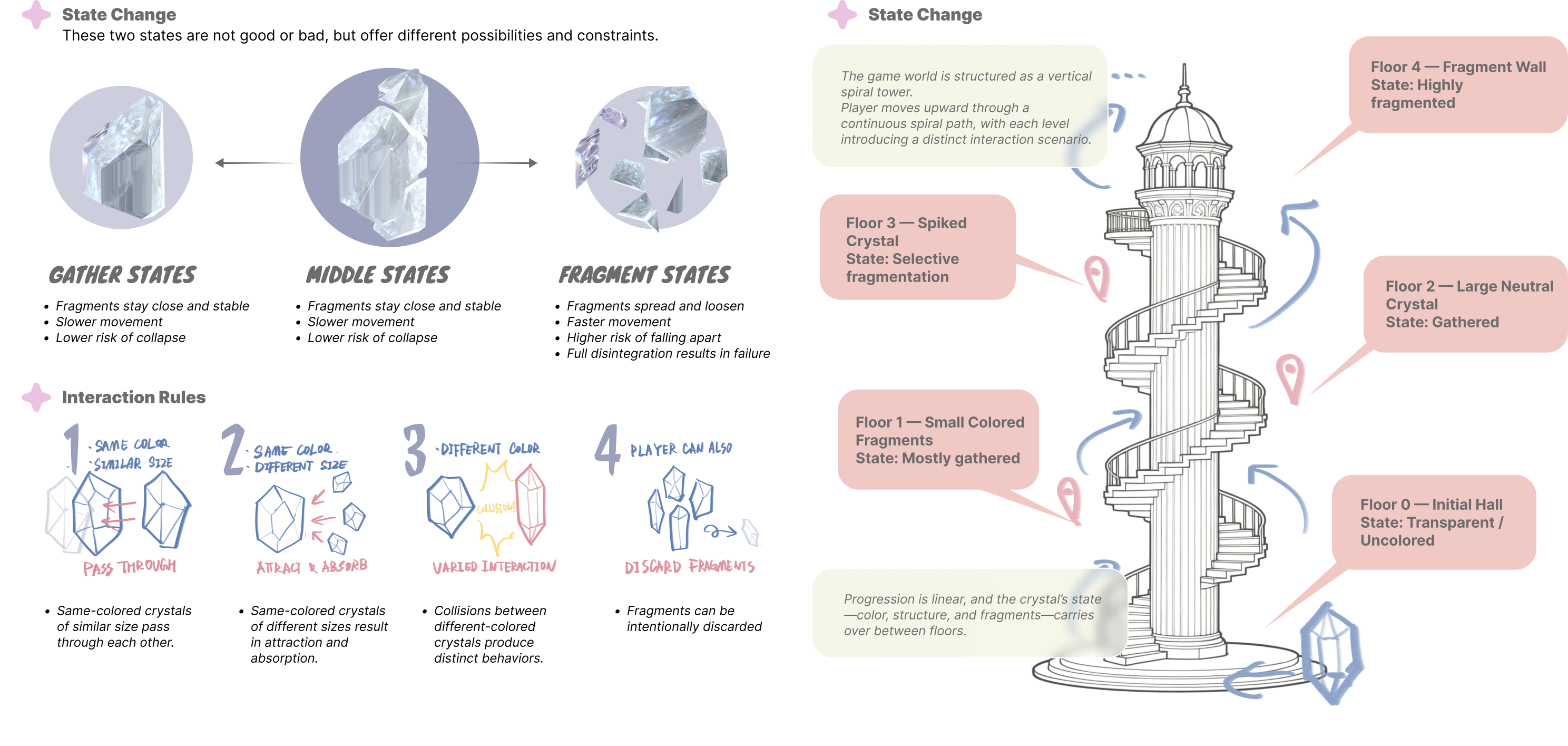
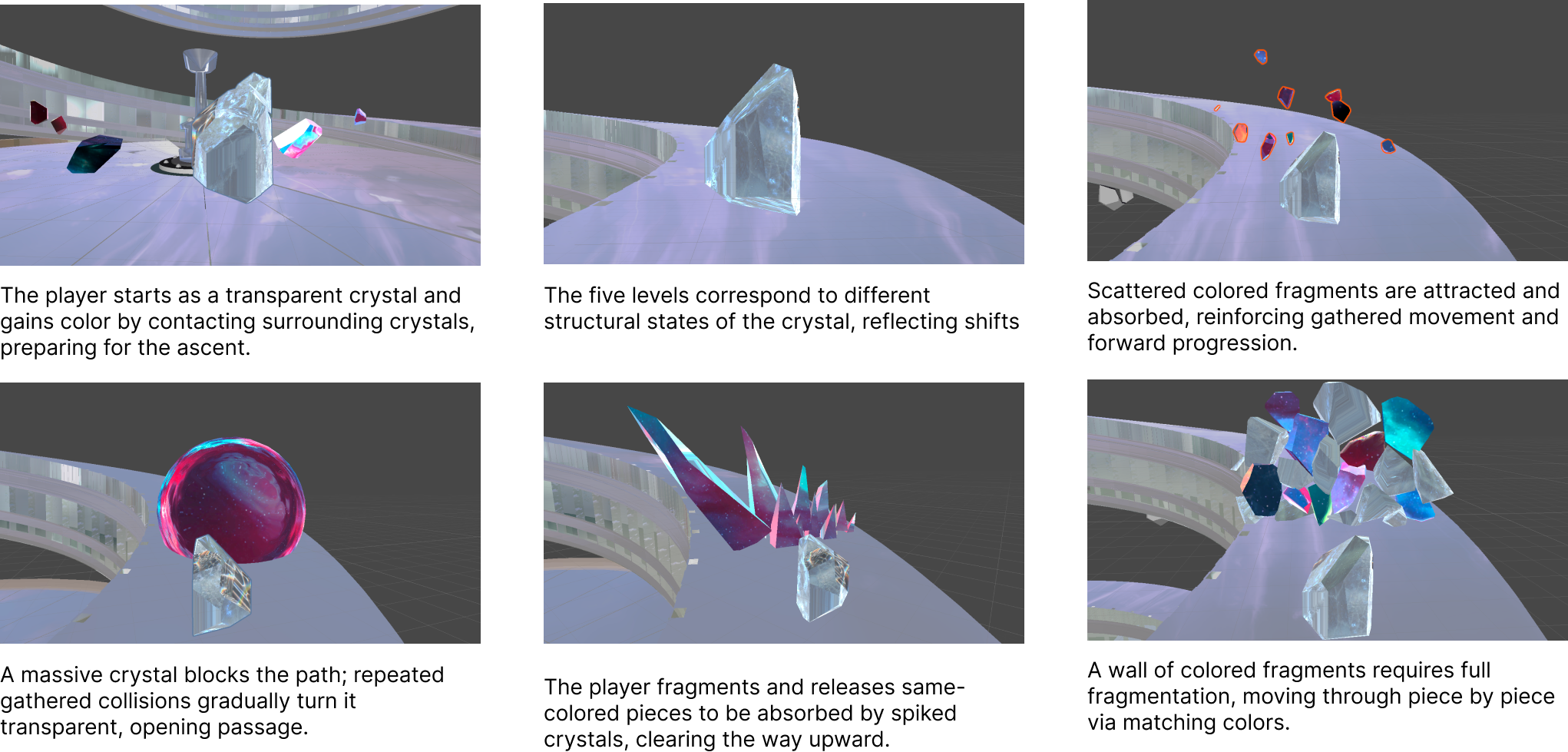
The player controls a transparent crystal that can shift between gathered and fragmented states while continuously moving forward.
Through interacting with other crystals, the player adjusts structure, color, and quantity, which persist across levels and shape all subsequent interactions.
Rather than offering a fixed goal or optimal form, the game presents identity as something formed through ongoing negotiation between stability and change.
Mechanics
development
final work